On this course, you will follow one particular case of a business deal between a Czech company and a British businessman and learn how to conduct negotiations in English with everything that accompanies such negotiations, and you will also learn useful language for various situations which can arise while negotiating.
The CzechTrade Promotion Agency (CzechTrade) was established by the Ministry of Industry and Trade of the Czech Republic in 1997.
Apart from other activities, they help Czech companies find business partners abroad, and vice versa they help foreign companies find Czech business partners. They organize meetings between potential partners, trade fair participation, and training courses.
“Writing without thinking is like shooting without aiming.” Arnold Glasow
 Abbreviations and acronyms in emails and letters
| Vocabulary | Definition |
|---|---|
| a/b | actual budget |
| AKA | also know as |
| a/o | account of (on behalf of) |
| AOB | any other business |
| attn | for the attention of |
| cc | copy to |
| c/o | care of (on letters: at the addressof), e.g. ABC Company, c/o John Smith |
| Co | company |
| COB | close of business(usually 5PM),e.g. Please submit your bid by COB Friday |
| dba | doing business as |
| dept | department |
| e.g. | exempli gratia (for example) |
| EOF | end of file, end of message |
| ETA | estimated time of arrival |
| i.e. | id est (meaning: "that is") |
| FYI | for your information |
| NB | please note, e.g. NB: I'm on holiday next week, so I won't be able to help you. |
| P.O. | purchase order |
| TIA | thanks in advance |
| RFQ | request for quotation |
Business English etiquette tip:
Before you contact a foreign company, it's advisable to find out about their correspondence customs - if they prefer letters or e-mails. In one country sending a letter might be taken as very oldfashioned while in another it might be taken as an act of respect. It might vary country from country. Please find more information about your particular country of interest on the Internet.
Business English tip:
As for the language, never use short forms such as I'm, you've, etc. in a letter. Always use full form such as I am, you have, etc. You should avoid using informal language such as phrasal verbs or idioms. So, for example, instead of 'carry on' you should use 'continue'.
Practical tip: It's not likely you are going to write you letter with your hand, but written in a word processor, it might look impersonal. To add it handwritten look use CopyDoodles©. Check their website: www.copydoodles.com

Cold calling refers to the first telephone call made to a prospective customer or business partner. The word "cold" is used because the person receiving the call is not expecting a call or has not specifically asked to be contacted.

be brief. It's hard enough to get someone to take your call and listen beyond a few seconds. The last thing you want to do is launch into a lengthy, convoluted message. Get to the point. Skip a "how-are-you" phase and small talk. The prospects appreciate directness. State your purpose, what's in it for the customer and your request (a meeting, for example), in as few sentences as possible.
be positive and prepared. Know who you're calling and what you plan to say.
be rigid. Each person is different, and the conversation might take turns. Be prepared to ask more questions and adjust your message to the situation.
be "real" - be yourself. Nobody likes a canned, robotic message. You'll benefit by being authentic.
forget that it's all about what's right for the prospect, and not just about making the meeting. Tailor your approach and let them know you are OK with it if they decline, if that's what's best for them.
focus on the "close." Sure, you want to get a meeting, but what you're really after is the truth of where the prospect stands, so make it easy for them to tell you.
carefully craft your message. Being "authentic" doesn't mean shooting from the hip. You still want to prepare a message that sounds interesting, natural and avoids industry buzzwords, jargon and clichés. Well-chosen words make prospects more comfortable.
try to counter all objections. That's likely to generate resistance. Instead, dig a little deeper to find out what's really behind the objection.
let the prospect ask questions and give them answers. You'll build trust.
hang up without suggesting some type of follow-up - another call, a meeting or something.

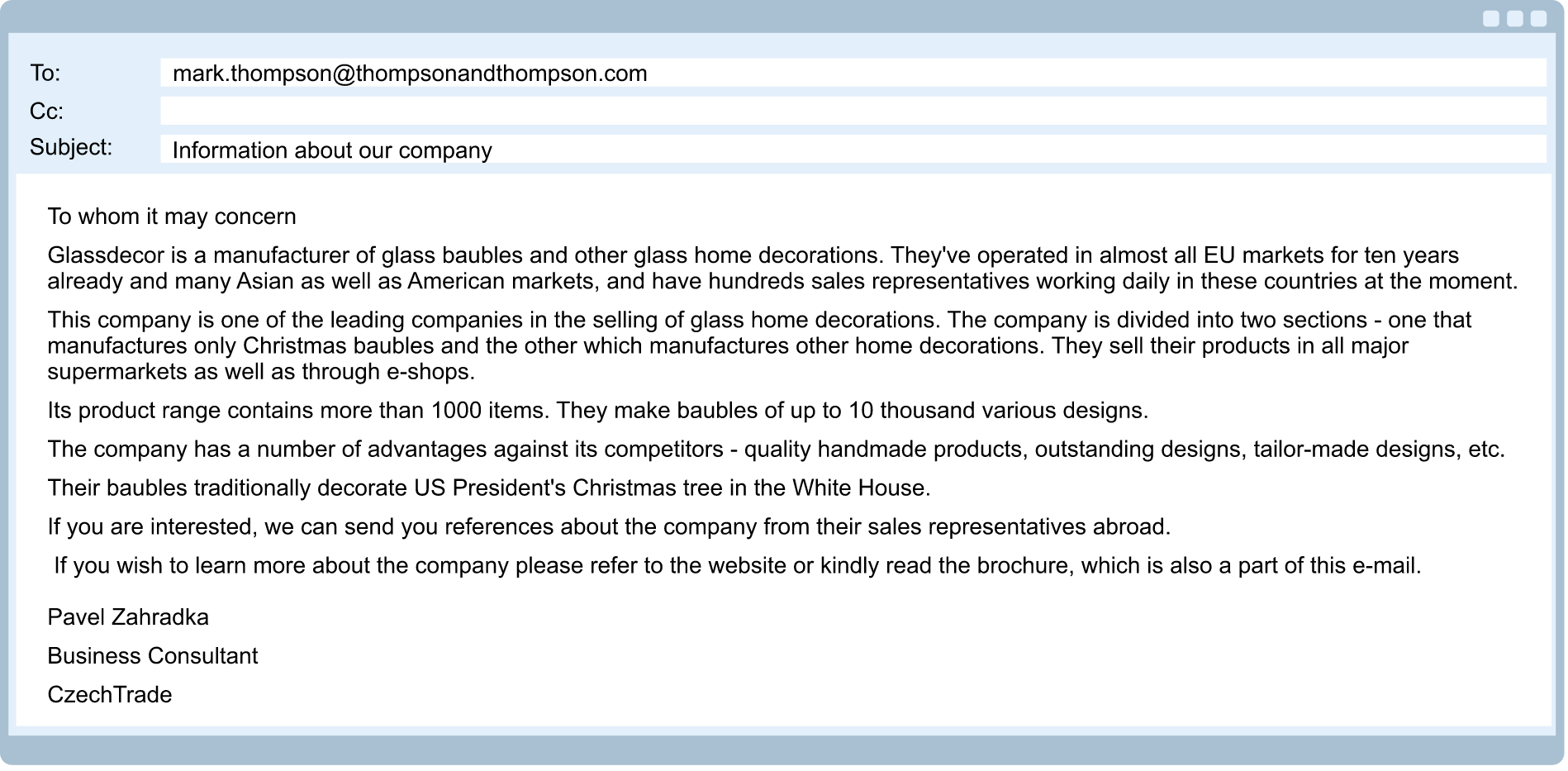
In business e-mails use only short sentences. Be as brief as possible while conveying all necessary information.